
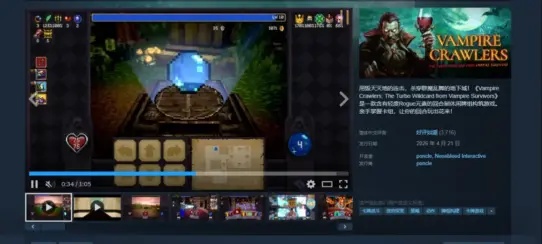
For players used to quick bursts of tension between a BD Cricket Match and other short-session entertainment, playing Slay the Spire can feel like making an elaborate cake by hand in a bakery: laying the base, spreading the cream, adding the fruit, and slowly building something complex but delicious. By comparison, Vampire Crawlers The Turbo Wildcard from Vampire Survivors, hereafter Vampire Crawlers, feels more like standing at the serving counter for pudding. You only need to open your mouth, and the pudding keeps arriving. It may not taste as rich as the cake, but it is easy to get and keeps coming.
The thrill of traditional card games usually lands when a carefully built deck finally starts running. That is delayed gratification. Players clear stages, collect cards with different traits, then decide which ones are worth keeping and which ones should be removed. It is a long process, and the roguelike randomness adds even more uncertainty. Not every card arrives according to your plan, so the game asks for a certain level of skill. When a powerful deck finally comes together and starts firing, every earlier decision suddenly proves its value.
The fun of Vampire Crawlers comes from how simple and approachable it is. Players can get strong positive feedback almost immediately. The game does not demand heavy deck-building knowledge, because most card effects are straightforward and broadly similar, with the main differences coming from numbers. After finishing the tutorial, players unlock an artifact called Pancake Stack. Its effect grants a combo multiplier when cards are played in ascending mana cost order. In plain terms, if you play a sequence, the card effects rise sharply as the combo multiplier stacks. For example, Torch only deals 45 damage at first, but after one combo layer it reaches 90, and the number can keep climbing. Even cards that look weak can become powerful through combos, which means you do not need to wait until the entire deck is complete. The feedback kicks in from the opening hand and keeps the pleasure curve moving until the end.
To make sequencing feel even smoother, the game also includes wild cards that break the usual order restriction. A wild card can connect with cards of any cost, making transitions much easier and neatly solving the problem of card costs ranging only from 0 to 5. For example, when you play a 3-cost card but have no 4-cost card, a wild card can bridge perfectly into a 5-cost card. After that 5-cost card, another wild card can lead into a 0-cost card, letting the chain begin again without breaking the combo. As long as you have enough wild cards, stacking more than a hundred combo layers in one turn becomes almost casual, and card values can easily climb into the thousands or tens of thousands. Playing so many cards in one turn also does not mean you must constantly worry about running out of mana. The game has items that raise your mana limit and cards that restore mana, so players only need to slip in a couple of mana cards while building sequences. Before long, the hand keeps moving, and you are off to the races.
After the tutorial, apart from the newly unlocked Pancake Stack and the familiar Antonio the Whip Man, you have almost nothing. Still, the early-game phase is exactly when players should learn the mechanics, explore different styles, and unlock items along the way. Antonio is your first explorer. Explorers provide stat bonuses and give players exclusive explorer cards, which create passive effects with limited trigger counts after being played. Antonio’s effect strengthens power by 10 percent whenever a red card is played. That sounds strong, but after two runs, you will quickly notice that buffs matter, while mana matters even more. Mana affects your combos and the number of cards you can play, setting the floor for your entire run. During my early attempts, the 2-mana limit often stopped me from playing 0, 1, 2 sequences, and I kept running into walls so often that I nearly quit. Luckily, after one Antonio run, you can unlock a new explorer, Imelda. Her effect raises the mana limit by 1, which arrives like a gift in the snow. With 3 mana, you can squeeze in one more combo and double your card value again.
Now the mana problem is temporarily eased. You can usually empty your hand every turn and may even have mana left over. But mana does not carry into the next turn, so any leftovers are simply wasted. The best place for unused resources is on the board. How do you spend them all? Taking more high-cost cards seems possible, but too many of them can clog your hand and become impossible to play. There is another route: make sure you have enough cards in hand each turn, so you can spend more mana and stack more combos. High-cost cards burn mana quickly, while a larger hand lets you use more mana across more plays. Conveniently, the new character Pasqualina, unlocked in the Inlaid Library, solves the hand-size issue. Her effect gives you 1 extra card in hand whenever you play a purple card. It almost feels deliberately arranged by the developers, guiding you step by step toward understanding the importance of mana and hand size, then giving you the exact character needed to solve the problem.
Pasqualina can also help solve the mana issue once and for all. When choosing cards, prioritize purple Mana Books as much as possible. By increasing your hand size and using wild cards to extend combos, you can gain 15 mana in a single turn and unlock Mana Siphon, an arcane card. Arcane cards become available after clearing the Rage Forest. Mana Siphon increases your mana limit by 1 every time you play a card. At that point, Pasqualina’s job is complete. While using her, you have probably already noticed that her weapon damage is excellent against groups but poor against single enemies, which makes boss fights inefficient. Once again, damage becomes the main problem.
For anyone balancing a BD Cricket Match break with a quick roguelike run, the timing feels almost too convenient, because after clearing Mad Forest you unlock Gennaro, whose explorer effect deals 60 damage every time a red card is played. Red cards have low costs, so multiple red cards can be played in one turn, triggering the passive repeatedly while also stacking Mana Siphon quickly. Once mana is no longer a problem, you can build combos with confidence and push toward upgraded weapons. At that stage, the run starts cutting through enemies like a hot knife through butter. From here, the early-game difficulty drops sharply, and the transition into the midgame comes very quickly.